
How to Brew Coffee Without Electricity: 2026 Camp Guide
Table of Contents
- What You'll Need Before You Start
- How to Boil Water for Coffee While Camping
- How to Brew Coffee Without Electricity: 4 Manual Methods
- Best Manual Coffee Makers for Camping
- Cowboy Coffee Brewing Method
- Coffee-to-Water Ratios for Manual Brewing
- Water Quality and Filtration in Emergencies
- Common Mistakes to Avoid
- Frequently Asked Questions
Last Updated: September 30, 2026
What You'll Need Before You Start
Brewing coffee without electricity comes down to three things: a heat source, a manual grinder, and a simple brewing device. Get those sorted and a power outage or backcountry morning never costs you a decent cup.
At Old Guy Outdoors, we've packed for enough fishing trips and UTV weekends to know the gear list matters more than the technique. Here's the short version:
- Heat source: camp stove, propane or butane burner, or a fire
- Manual grinder: hand burr grinder, or pre-ground coffee as a backup
- Brewing device: French press, pour-over cone, moka pot, or just a pot
- Potable water: at least 500 ml per cup, plus extra for rinsing
- Filter: paper filters or a metal mesh filter
- Insulated mug: keeps the second cup warm while you pack up
The one item people forget is a backup. If your stove fails, a pot and a fire still make coffee. If your grinder jams, pre-ground beans save the morning.
How to Boil Water for Coffee While Camping
Boiling water for coffee while camping is simple: heat 500 ml of water per cup until it reaches roughly 90-96°C, just below a rolling boil. Pull it off the heat before a hard boil, then let it rest 30 seconds before pouring.
That temperature range matters. Water near boiling point extracts flavor fast, and a hard boil scalds the grounds and turns the cup bitter. Watch for small bubbles rising, not a violent roil.
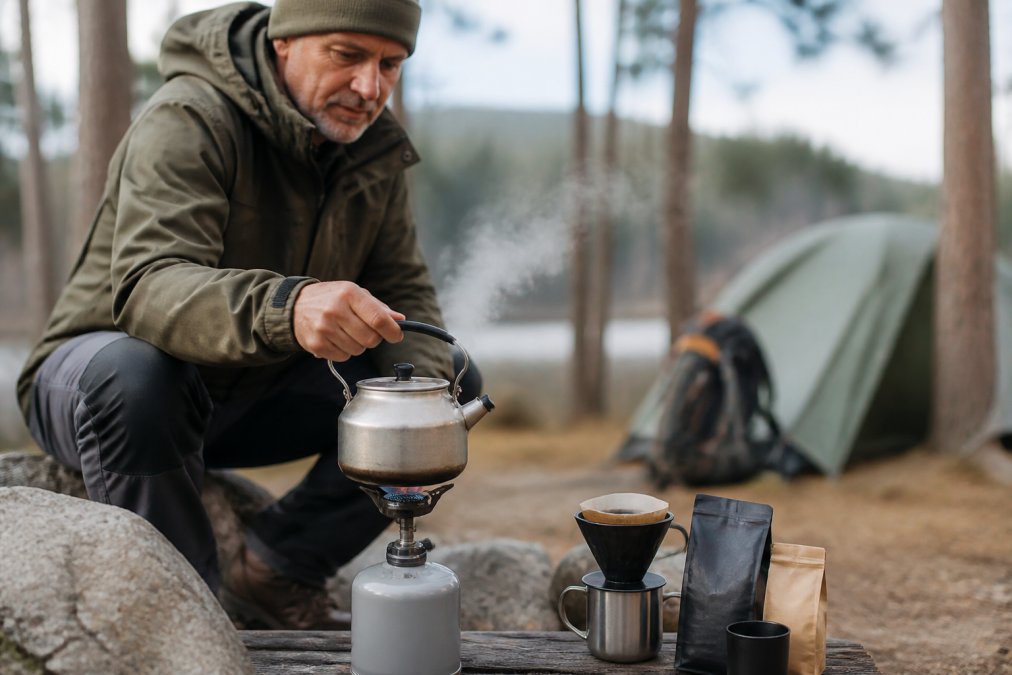
Camp Stove Setup and Fuel Choices
Propane and butane burners heat water fastest and give you control. A small canister stove brings 500 ml to temperature in a few minutes, even in wind.
Liquid-fuel stoves burn hotter and work better in cold weather, but they need priming and a steady hand.
- Canister stove: easiest, best for short trips
- Liquid fuel: best in cold, more fuss
- Fire or coals: free, slowest, needs a sturdy pot
Safety Precautions During Power Outages
Never run a camp stove, propane burner, or charcoal grill indoors. Carbon monoxide builds fast in a closed space and you cannot see or smell it.
How to Brew Coffee Without Electricity: 4 Manual Methods
Learning how to brew coffee without electricity gives you four reliable options, and each one suits a different setup. The method you pick depends on your gear, how much fuel you have, and how much time you can spare.
Here's how the four compare:
| Method | Time | Grind | Fuel Needed | Best For |
|---|---|---|---|---|
| French press | 4-5 min | Coarse | Yes (water heating) | Full-bodied cup, easy cleanup |
| Pour-over | 3-4 min | Medium | Yes (water heating) | Clean cup, light gear |
| Moka pot | 5-6 min | Fine | Yes (stovetop) | Strong, espresso-style coffee |
| Cold brew | 12-18 hrs | Coarse | None | No heat source needed |
French Press Brewing Method
The French press is immersion brewing at its simplest. Add coarse grounds, pour hot water over them, wait four minutes, then press.
Pour-Over Techniques
Pour-over is gravity-fed brewing, and it rewards a steady hand. Set a filter paper or metal mesh filter in your cone, add medium grounds, and pour in stages.
Moka Pot on a Gas Stove
A moka pot on a gas stove makes strong coffee by pushing steam through fine grounds. Fill the basket level, add water to the valve, and set it on low heat.
Cold Brew Coffee Without Electricity
Cold brew is the only method here that needs zero fuel, which makes it the single most reliable option when your power is out for days or your stove fuel is running low. No flame, no canister, no waiting for water to heat.
Best Manual Coffee Makers for Camping
The best manual coffee makers for camping are the ones that survive a pack, a truck bed, and a windy morning. Durability and simple cleanup beat fancy features every time.
Cowboy Coffee Brewing Method
The cowboy coffee brewing method is the oldest trick here: boil water, add grounds, and let them settle. No filter, no press, just a pot and patience.
Coffee-to-Water Ratios for Manual Brewing
Getting the coffee-to-water ratio right matters more than any gadget. Too little coffee gives you weak, sour water; too much wastes beans and turns bitter. When you can't rely on an automated machine, the ratio is the one variable you control.
Use this as your starting point:
- French press: 1:15 (about 2 tbsp per 250 ml)
- Pour-over: 1:16
- Moka pot: fill the basket level, don't tamp
- Cold brew: 1:8 for concentrate, 1:15 for ready-to-drink
- Cowboy coffee: 1:14, then adjust
How to Measure Without a Scale
A small digital scale removes the guesswork and makes every cup repeatable, even in the dark. But if you don't have one, use these approximations:
- 1 tablespoon of whole beans yields about 5-6 grams of ground coffee, depending on the bean and grind size.
- 1 standard coffee scoop (typically 2 tablespoons) holds about 10-12 grams.
- A heaping tablespoon of coarse grounds is roughly 7-8 grams.
Why Grind Size Changes the Ratio
Grind size and ratio work together. A finer grind exposes more surface area and extracts faster, so you can use slightly less coffee for the same strength. A coarser grind extracts slower, so you may need a touch more. This is why a moka pot (fine grind) uses a full basket with no tamping, while a French press (coarse grind) needs a longer steep.
Ratios When Water Quality Is Poor
In an emergency, water quality affects extraction. Hard water with high mineral content can mute flavors and slow extraction, so you may want to use a slightly higher coffee ratio (1:14 instead of 1:15) to compensate. If you've boiled and filtered questionable water, let it cool to brewing temperature before measuring, hot water changes the volume slightly and can throw off volume-based measurements.
A Simple Rule for Any Method
When in doubt, start with 1:15 by weight. That's 1 gram of coffee for every 15 grams of water. For a 300 ml mug, use 20 grams of coffee. For a 500 ml French press, use 33 grams. Write the ratio on a piece of tape on your coffee jar so you don't have to remember it in the dark.
Water Quality and Filtration in Emergencies
Water quality decides how your coffee tastes, and in an emergency it decides whether it's safe to drink. Coffee masks bad water, but it doesn't make it safe.
Common Mistakes to Avoid
Most bad camp coffee comes down to a few repeat mistakes, not bad beans. Fix these and your cup improves immediately.
- Boiling the grounds: scalds the coffee and adds bitterness. Pull water off before a hard boil.
- Wrong grind size: fine grounds clog a French press; coarse grounds make weak pour-over.
- Skipping the bloom: trapped gas blocks extraction, so the first pour tastes flat.
- Ignoring the wind: an exposed flame wastes fuel and slows your boil.
- Reusing wet grounds: they turn stale fast. Brew fresh each time.
Frequently Asked Questions
What type of coffee maker doesn't require electricity?
Manual coffee makers that don't need electricity include French presses, pour-over cones, moka pots, and AeroPress-style pressers. These rely on gravity, immersion, or stovetop heat. For camping, a French press or pour-over cone with paper filters works well because they're lightweight and easy to clean. A moka pot needs a heat source but no plug. Cold brew systems also work without power, though they take 12-24 hours to steep. Each method gives you full control over grind size, water temperature, and steeping time to make coffee without electricity.
How do you boil water for coffee without a stove?
Without a stove, you can boil water using a campfire, a portable propane or butane camp stove, or a backpacking stove. If you're in a power outage, a gas grill or fireplace works too. Always use a dedicated kettle or metal pot, and never burn charcoal indoors due to carbon monoxide risk. For fuel efficiency, use a lid and a wider pot to catch more heat. Bring water to a rolling boil, then let it cool for 30-60 seconds before pouring over coffee grounds to avoid scorching. This method is central to how to boil water for coffee while camping.
Can you make cold brew without electricity?
Yes, cold brew coffee without electricity is simple. Combine coarse-ground coffee and cold water in a jar or pitcher at a 1:8 ratio (coffee to water). Stir, cover, and let it steep at room temperature or in a cool spot for 12 to 24 hours. Then filter through a metal mesh filter, cloth, or paper filter. Cold extraction yields a smooth, full-bodied concentrate you can dilute with water or milk. It's ideal for off-grid situations because it requires no heat source and minimal equipment, just time and patience.
What is the best non-electric coffee maker for camping?
The best non-electric coffee maker for camping depends on your priorities. A French press offers full-bodied coffee and is easy to use, but it's bulky and leaves sediment. A pour-over cone is lightweight, produces a clean cup, and packs flat. A moka pot makes strong, espresso-like coffee but needs a stove. For backpacking, a lightweight pour-over or AeroPress-style press is ideal. For car camping, a French press or percolator works well. Consider your group size, pack space, and how much cleanup you're willing to do.