
Best Coffee for Outdoor Adventure Trips: 2026 Guide
Table of Contents
- Best Coffee for Outdoor Adventure Trips: Quick Comparison
- Best Portable Coffee Makers for Camping
- Best Coffee for Backpacking: Weight and Packability Matter
- Instant Coffee for Hiking: Fast, Lightweight, No Cleanup
- How to Make Coffee While Camping: Methods and Gear
- Coffee Flavor and Roast for Trail Adventures
- Storage, Freshness, and Weather Resilience Outdoors
- Frequently Asked Questions
Last Updated: October 17, 2026
Best Coffee for Outdoor Adventure Trips: Quick Comparison
When you're planning an outdoor adventure, coffee isn't just a morning ritual, it's fuel for the journey. The challenge is finding a format that balances flavor, weight, preparation speed, and cleanup requirements. The best coffee for outdoor adventure trips depends entirely on your trip type, group size, and how much you're willing to carry.
Some adventurers swear by instant packets. Others insist on whole beans and a portable coffee maker. The truth is that no single option wins across all scenarios. A solo backpacker has different priorities than a car-camping group, and a weekend trip calls for different solutions than a week-long expedition.
Below, we'll walk you through the formats, brewing methods, and specific options that work best for different outdoor scenarios. We'll also cover the practical constraints that most guides skip: water requirements, fuel needs, cleanup time, and how to keep coffee fresh in varying weather conditions.
How We Evaluated These Options
We assessed each coffee format across six key criteria:
| Criterion | Why It Matters | What We Measured |
|---|---|---|
| Weight & Packability | Less weight = easier hiking | Ounces per serving |
| Preparation Time | Quick morning means more daylight | Minutes from water to cup |
| Water & Fuel Needs | Resource-intensive formats drain supplies | Liters of water; fuel type |
| Flavor Quality | Taste matters on the trail | Roast profile; freshness window |
| Cleanup Effort | Easier cleanup = less camp impact | Time and water required |
| Cost Per Serving | Budget matters on extended trips | Price divided by servings |
This framework helps you match coffee format to your specific adventure constraints, not just pick what sounds convenient.
Best Portable Coffee Makers for Camping
Car camping and base-camp adventures give you room to prioritize flavor and ritual over weight. A portable coffee maker transforms a campsite into a destination worth lingering at.
The enamel mug paired with a simple brewing method is the foundation of outdoor coffee culture. Old Guy Outdoors offers a lightweight enamel mug (3.14 inches tall, 3.25 inches diameter, lead and BPA-free) that attaches to your pack and doubles as both brewing vessel and drinking cup.
For brewing methods, the choice comes down to simplicity versus flavor complexity. A basic metal pour-over cone or a simple immersion method works best when you're sitting still. Both require minimal cleanup and no moving parts to break.
The real advantage of car camping is that you can bring coffee beans you actually enjoy. Whole bean coffee stays fresher longer than ground coffee, and the ritual of grinding beans by hand each morning becomes part of the adventure.
What most guides miss: enamel mugs stain easily with coffee. That's not a defect, it's normal for enamel. Apply lemon juice or baking soda to remove stains if appearance matters to you. More importantly, don't heat liquids directly in the mug over a flame; the enamel coating can damage.
Best Coffee for Backpacking: Weight and Packability Matter
Backpacking changes the equation entirely. Every ounce counts, and you're moving through multiple camps. The best coffee for backpacking strips away ritual in favor of efficiency.
Instant coffee is the backpacker's answer. Old Guy Outdoors offers instant coffee with 30 servings per resealable pouch at $24.99, roughly $0.83 per serving. The pouch itself weighs just a few ounces, and each serving requires only hot water and a stir.

For hikers seeking something beyond basic instant, instant coffee with mushroom blend ($24.99 for approximately 42 servings) combines coffee with lion's mane, cordyceps, and reishi mushrooms.

The weight advantage is decisive: a week-long backpacking trip requires maybe 8-10 servings of coffee. Standard instant packets weigh roughly 3-4 ounces total. A comparable amount of whole beans would weigh twice that, plus you'd need to carry a grinder and brewing equipment.
Single-serve coffee capsules offer another option, though they're heavier than instant packets and require capsule-compatible brewing equipment. Old Guy Outdoors offers 12-pack single-serve capsules ($21.99) with sealed, oxygen-free packaging that preserves freshness.
The tradeoff with capsules is environmental impact. Leave No Trace ethics matter on the trail, you'll need to pack out every used capsule.
Instant Coffee for Hiking: Fast, Lightweight, No Cleanup
Day hikes and short trail excursions demand the simplest possible coffee solution. You're moving constantly, stopping only briefly, and carrying everything on your back.
Instant coffee is purpose-built for this scenario. It requires only hot water, no brewing equipment, no cleanup, no waste to pack out. A single packet takes 90 seconds from boiling water to ready-to-drink coffee. On a cold morning at 8,000 feet, that speed matters.
Old Guy Outdoors instant coffee comes in a resealable pouch, so you can portion individual servings into small bags or even drink directly from the pouch if you're in a hurry.
The flavor difference between instant coffee and fresh-brewed is real but diminishing. Quality instant coffee from freshly roasted beans tastes dramatically better than commodity instant from grocery stores. The roasting process and freeze-drying method matter far more than most hikers realize.
What most guides get wrong: instant coffee doesn't have to taste like instant coffee. The difference between a $2 instant packet and a $1 premium instant packet is enormous. If you're carrying coffee on a hike, the extra cost per serving is negligible compared to the flavor improvement.
How to Make Coffee While Camping: Methods and Gear
Base-camp coffee preparation becomes a ritual when you have time and aren't moving. The method you choose shapes the entire morning experience.
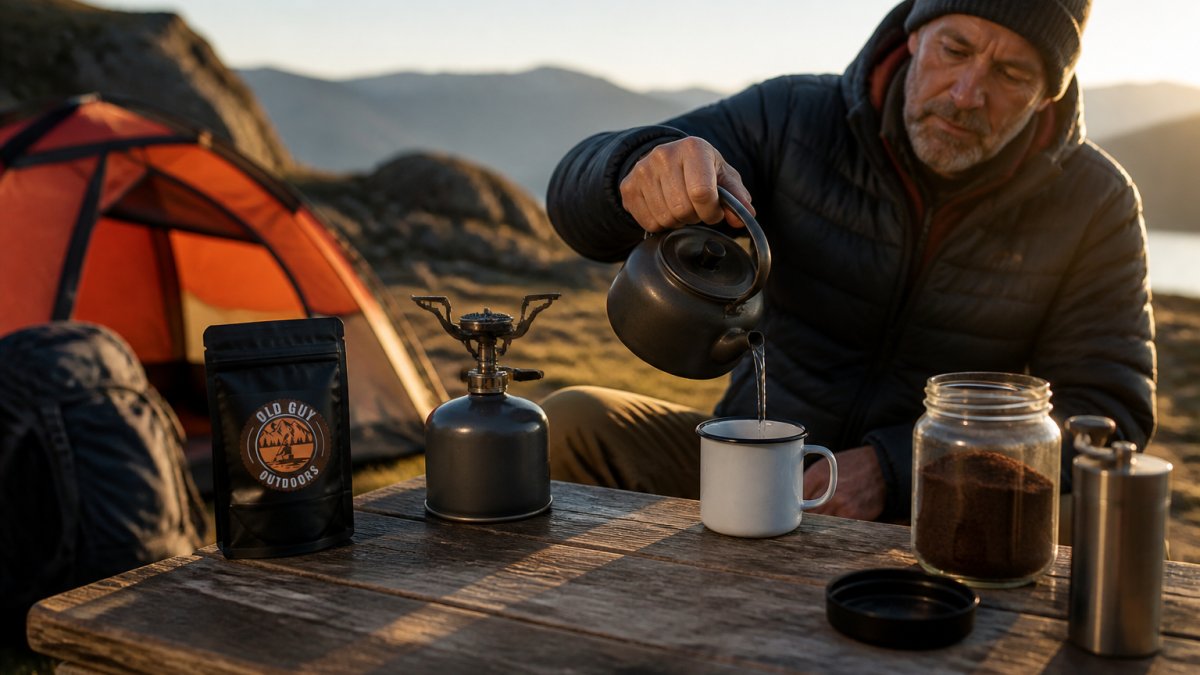
The simplest method is immersion: add ground coffee to your mug, pour hot water, let it steep for 4-5 minutes, and drink carefully to avoid grounds. This requires nothing beyond your mug and a heat source. It's messy but it works.
A slightly more refined approach uses a metal pour-over cone or filter. You place the cone over your mug, add a filter and ground coffee, and slowly pour hot water through. This takes 3-4 minutes and produces cleaner coffee with fewer grounds.
For groups or extended stays, a small camping coffee maker, whether a stovetop moka pot or a simple drip brewer, justifies the extra weight. These methods brew larger quantities and produce more consistent results. A moka pot works on any heat source and creates strong coffee.
Cold brew is worth considering if you have time. Cold brew coffee requires no heat and can be prepared the night before. Old Guy Outdoors offers cold brew coffee blends specifically formulated for this method, dark French roast with very coarse grounds at $24.99. Another variant offers medium roast with chocolate, toffee, and floral notes ($24.99), ideal for cold brew or nitro preparation.

Water, Fuel, and Cleanup Requirements by Method
Different brewing methods have hidden costs that become obvious after a few camps.
Immersion coffee requires the most water, roughly 8 ounces per serving plus extra for rinsing your mug. On a water-scarce camp, this adds up. Cleanup is minimal: drink carefully and rinse the mug.
Pour-over methods use similar water volumes and add a filter disposal step. Biodegradable filters can be scattered, but they take time to decompose. Some hikers carry used filters out entirely.
Instant coffee uses only the water needed for one cup, roughly 8 ounces, with no additional cleanup water. This makes it ideal for water-restricted camps or high-altitude locations where water is scarce.
Cold brew requires no fuel but needs 12+ hours of steeping time. You prepare it in the evening and drink it the next morning. This method is perfect for base camps where you're staying multiple nights.
Fuel consumption varies by method. A camping stove burns roughly 0.1-0.2 ounces of fuel per cup of coffee, depending on the stove type and heat source. Over a week-long trip, this adds up, fuel weight matters on long expeditions.
Coffee Flavor and Roast for Trail Adventures
Roast level shapes the entire coffee experience, and different roasts perform differently in outdoor conditions.
Dark roasts like Old Guy Outdoors Cowboy Blend ($24.99), a dark and medium blend with cocoa, caramel, and vanilla tones, deliver bold, recognizable flavors that hold up well in cold morning air.
Medium roasts offer more complexity and acidity. They taste brighter and more nuanced than dark roasts but can taste thin if the coffee cools too much. Medium roasts work better in warm-weather camping when you'll drink your coffee while it's still hot.
Light roasts emphasize origin characteristics and flavor notes from the specific beans. They're delicate and benefit from precise brewing temperatures. On the trail, light roasts often disappoint because the brewing conditions aren't ideal and the flavor profile gets lost.
For high-caffeine needs, Old Guy Outdoors offers Max Caf Blend ($24.99), a high-caffeine blend of Tanzania and India Robusta beans. Robusta beans contain roughly twice the caffeine of Arabica beans.
Freshness matters more than roast level. Coffee roasted to order retains volatile aromatics and flavor compounds that fade over weeks. Old Guy Outdoors roasts coffee specifically for your order, ensuring maximum flavor and aroma when it reaches you.
Storage, Freshness, and Weather Resilience Outdoors
Outdoor conditions degrade coffee quality faster than home storage. Heat, humidity, and temperature swings accelerate staleness.
Whole beans last longer than ground coffee because they have less surface area exposed to air. A sealed bag of whole beans stays fresh for 3-4 weeks after roasting.
Instant coffee is the most shelf-stable format. Freeze-dried coffee in a sealed pouch lasts for months without significant flavor loss. This makes instant coffee ideal for long expeditions or for stocking a remote cabin.
Cold brew concentrate in sealed bottles resists degradation better than hot-brewed coffee. The cold temperature slows oxidation, and sealed packaging prevents air exposure.
Weather protection matters more than most guides acknowledge. Rain and humidity penetrate paper bags and thin plastic.
Temperature swings affect coffee differently depending on format. Instant coffee is largely immune to temperature changes. Whole beans can become stale faster if exposed to heat and then cold repeatedly.
For extended trips, ration your best coffee for the beginning of the journey. Coffee quality matters most when you're fresh and can appreciate it.
The best coffee for outdoor adventure trips isn't about finding one perfect option, it's about matching format to your specific trip constraints.
Old Guy Outdoors delivers roasted-to-order coffee specifically designed for outdoor use. Whether you choose instant coffee for backpacking, cold brew blends for base camps, or specialty blends like Max Caf for high-altitude starts, you're getting maximum flavor and freshness without inventory management.
Frequently Asked Questions
What is the best coffee to take camping?
The best coffee for camping depends on your trip type and priorities. For car camping, whole bean or ground coffee with a portable brewing method like a pour-over or camp coffee maker offers cafe-quality flavor. For backpacking, instant coffee or single-serve capsules minimize weight and pack space. Old Guy Outdoors' Instant Coffee (30 servings, $24.99) and Cold Brew blends work for both scenarios, instant for lightweight trips, cold brew concentrate for base camp comfort.
Is instant coffee good for backpacking?
Yes, instant coffee is ideal for backpacking. It weighs almost nothing, requires only hot water, and produces zero cleanup, critical when water is scarce. Old Guy Outdoors' Instant Coffee with Mushroom (42 servings, $24.99) adds Lion's Mane - traditionally used in food cultures for its unique flavor and association with clarity and focus, Cordyceps - long valued in traditional practices for supporting stamina and vitality, and Reishi - often referred to as the “mushroom of balance,” appreciated for its calming and grounding qualities. Simply stir into hot water and drink. For minimalist trekking, instant is often the best choice.
What coffee maker is best for camping?
The best camping coffee maker depends on group size and fuel availability. Pour-over drippers are lightweight and durable for backpacking. For base camp car camping, a traditional camp coffee maker or French press offers robust flavor and durability. Pair any method with Old Guy Outdoors' Cold Brew blends or Cowboy Blend (dark and medium roast with cocoa, caramel, and vanilla tones, $24.99) for cafe-quality results without electricity.
How much coffee should you bring on a camping trip?
Plan for one serving per person per day, plus one extra for emergencies. Old Guy Outdoors' Instant Coffee (30 servings, $24.99) covers a solo trip or small group for several days. For longer trips, instant and single-serve capsules pack efficiently, the 12-pack capsules ($21.99) weigh less than ground coffee and stay fresh sealed. Cold brew concentrate requires more volume but fewer servings, so calculate based on your brewing method and trip length.