
How to Recycle Coffee Grounds While Camping
Table of Contents
- Why Recycling Coffee Grounds While Camping Matters
- How to Dispose of Coffee Grounds While Camping
- Packing Out Coffee Grounds: A Practical System for Wet Grounds
- Composting Coffee Grounds While Camping
- Camping Coffee Waste Disposal by Campsite Type
- Camping-Specific Reuse Ideas for Spent Coffee Grounds
- Common Mistakes to Avoid When Recycling Coffee Grounds
- Conclusion
- Frequently Asked Questions
Last Updated: October 12, 2026
Why Recycling Coffee Grounds While Camping Matters
Learning how to recycle coffee grounds while camping keeps your campsite clean and your pack light.
That last point is the one most campers miss. A banana peel tossed in the bushes is still a wildlife magnet. Coffee grounds are no different.
Get this right and you leave a site better than you found it. Get it wrong and you train animals to raid campsites for years.
How to Dispose of Coffee Grounds While Camping
The best disposal method depends on your campsite type, group size, and local rules. You have four real options: pack them out, bury them, compost them, or reuse them. Packing out works everywhere. Burying and composting only work in specific settings.
Here is the quick decision guide:
| Method | Works Where | Effort | Best For |
|---|---|---|---|
| Pack out | Everywhere | Low | Backcountry, bear country, wet grounds |
| Bury | Remote sites only | Medium | Dispersed camping, deep soil |
| Compost | Home or camp bin | Medium | Base camps, long stays |
| Reuse | Everywhere | Low | Small amounts, camp chores |
Most campers should default to packing out, the only method with zero wildlife risk.
Separating Grounds From Filters and Pods
Separate grounds from paper filters first. Filters are compostable at home but slow down burial and add bulk to your pack; a quick shake over your container does the job.
For pods and capsules, you cannot separate grounds from the plastic shell without a knife and patience. Pack those out whole, never leave a pod behind thinking it will break down. Most do not.
Burying Grounds: When It's Acceptable and When It's Not
Burying works only in remote, dispersed camping areas with deep organic soil. Dig a hole 15 to 20 cm deep, at least 60 metres from water, trails, and campsites. Mix the grounds into the soil, then cover and pack the topsoil back down.
Skip burial in these situations:
- Bear country or any area with food-storage rules
- Alpine, desert, or rocky terrain with thin soil
- Campgrounds with designated waste systems
- Anywhere within 60 metres of a water source
Burying concentrates food smell in one spot. In high-use areas, that spot becomes a wildlife target.
Packing Out Coffee Grounds: A Practical System for Wet Grounds
Packing out coffee grounds is the simplest and safest method, and wet grounds are no problem with the right container. The trick is sealing them before they leak into your pack. A dedicated grounds container solves this in seconds.
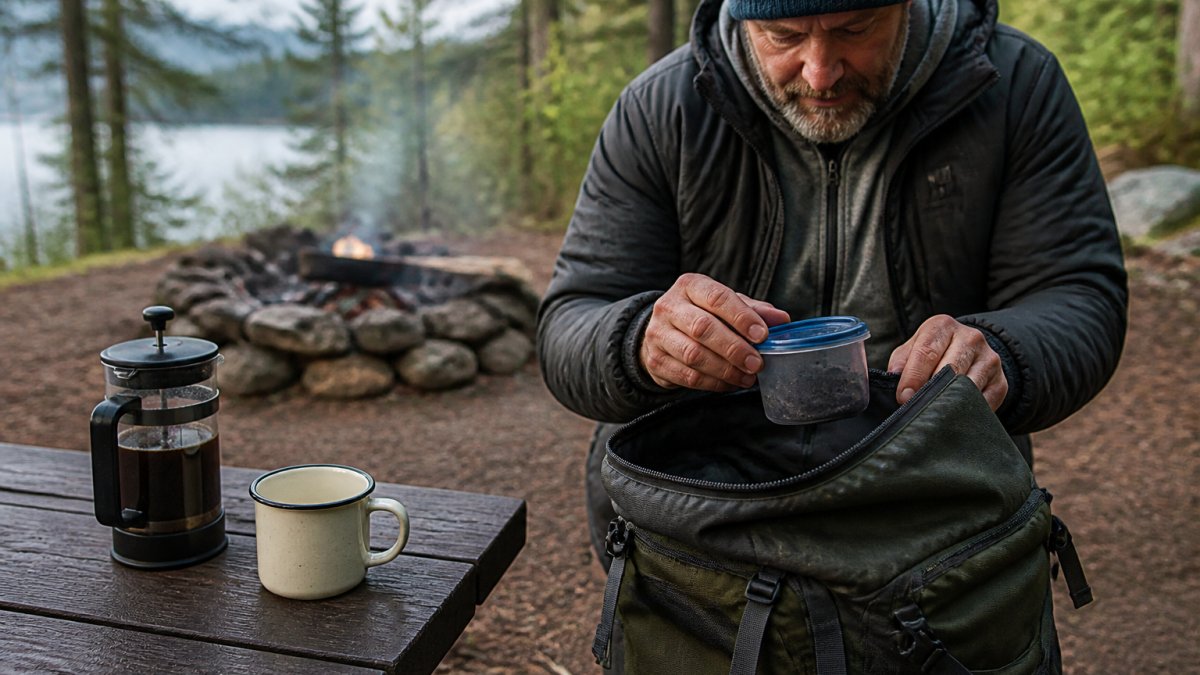
Containment Options for Wet Grounds
A leak-proof jar or screw-top bottle handles wet grounds best; line it with a compostable bag for an easy dump later. Double-bagging in a zip-top bag works for short trips but tears easily.
Whatever you choose, keep it separate from your food. Store it in an outside pocket or hang it with your bear bag where rules require it.
Composting Coffee Grounds While Camping
Composting coffee grounds while camping works only at base camps or long-stay sites where a compost system already exists. Grounds are a green material that adds nitrogen, so you still need carbon-rich material like dry leaves or paper to balance them.
Layer grounds with dry material at roughly one part grounds to two parts carbon. Turn the pile every few days. A hot pile breaks grounds down in weeks; a cold pile takes months.
On-Site Composting vs. Carrying Grounds Out
On-site composting makes sense at a permanent base camp with an established bin; carrying grounds out makes sense everywhere else. If you move camp each day, a compost pile never gets hot enough to work, and you leave food waste behind for wildlife.
Camping Coffee Waste Disposal by Campsite Type
Disposal rules change with the site, the land manager, and the season. Use the site type below to pick a method, then confirm with the land manager or posted rules before you commit.
Established Campgrounds
Use the dumpster, trash can, or provided organic waste bin. If the campground has a dishwashing station or grey-water drain, that is the place for the watery part of your grounds, not the fire ring, bushes, or tent pad.
- Never dump grounds in the fire ring. They smoulder, smell, and leave a residue that the next camper inherits.
- Never pour them down a vault toilet or pit toilet. The liquids overload the vault and the solids do not break down the way the system expects.
- If the campground has bear-resistant food lockers, treat your sealed grounds container like food and store it there overnight.
Dispersed Camping on Public Land
Dispersed camping is the grey zone: some districts allow burying small amounts of food waste, others prohibit it outright. The safe default is to pack out. If you bury, do it only where all of the following are true:
- You are at least 60 metres (about 200 feet) from water, trails, and campsites.
- The soil is deep enough to dig a 15-20 cm hole without hitting rock or roots.
- You are not in bear country or any area with food-storage regulations.
- You are not in alpine, desert, or cryptobiotic-crust terrain, where soil recovery takes decades.
Mix the grounds into the soil rather than leaving them in a clump, then replace and pack the topsoil. A clump is a concentrated smell signal; mixed into soil, it disperses faster.
Backcountry and Wilderness Sites
Pack out everything, no burial, no scattering, no fire ring. Wilderness areas and many national parks require human and food waste to leave with you, and coffee grounds count as food waste. A sealed container in your pack is the only always-compliant method.
Base Camps and Long Stays
A base camp is the one setting where on-site composting can work, and only if a bin already exists and the land manager permits it. Building the pile yourself creates a wildlife attractant that outlasts your stay, pack out instead.
RV and Car Camping
RV and car campers have the easiest options and the most temptation to cut corners.
- RV with a sealed waste tank: Grounds can go in the trash, not the black tank. The black tank is for human waste; coffee grounds sink, clump, and contribute to sensor false-readings.
- RV with a galley grey tank: Small amounts of grounds are tolerable, but they settle in the tank and in the P-trap. A strainer at the sink is the cheap fix.
- Car camping with a cooler and bins: Keep a dedicated sealed grounds container with the rest of your camp kitchen, and empty it at the campground dumpster or take it home.
Free and Stealth Camping
Treat free camping like dispersed camping, but with less margin for error: you often do not know who manages the land, and enforcement can be stricter. Pack out. On private land with permission, ask the landowner where they want organic waste, do not assume the compost pile or field edge is fair game.
The Decision Rule
The pattern is simple: the more remote the site, the stricter the rule, and the less certain you are about the land manager, the more you should default to packing out, the only method with zero wildlife risk and zero regulatory ambiguity.
Camping-Specific Reuse Ideas for Spent Coffee Grounds
Most reuse lists are written for a kitchen, not a campsite. Outdoors, the question is not just "can I reuse this?" but "does reusing it create a wildlife, fire, or gear problem?" Here is an honest assessment of the common ideas.
Worth Doing at Camp
Pot scrubbing. Spent grounds are a mild abrasive that cuts grease and burnt-on residue without soap, which matters where grey-water dispersal is required.
Fire starter. Dry grounds mixed into a cardboard or dryer-lint bundle extend burn time and add a slow smoulder.
Odour control in a sealed container. A thin layer of dry grounds in the bottom of your container absorbs some smell and reduces the wet-slurry problem.
Works, With Caveats
Fire ring and coal odour. Sprinkling dry grounds on coals produces a brief coffee smell, but it does not neutralise food odours or make a fire ring a safe place to leave food waste.
Fabric dye. Simmering grounds in water and submerging fabric produces a natural brown tone.
Garden and soil use at home. The best use for most campers' grounds is to carry them home and add them to a compost pile or garden bed.
Skip These at Camp
Scattering grounds around the site to mask food smells. This is the most common bad advice on the internet.
Burying grounds as a "reuse." Burial is a disposal method, not a reuse. Treat it with the same rules as any other food waste.
Adding grounds to a bear bag or hang. Grounds are food waste.
The Reuse Rule of Thumb
If a reuse keeps the grounds sealed, dry, or headed home, it is probably fine. If it spreads the grounds, smell, or residue around your site, it is a wildlife problem dressed up as a hack. When in doubt, seal the container and pack it out.
Common Mistakes to Avoid When Recycling Coffee Grounds
The biggest mistake is dumping grounds in the fire ring or tossing them into the bushes. Both leave food waste behind and attract animals. A second common error is burying grounds too shallow, where rain and animals uncover them fast.
Watch for these too:
- Leaving pods or filters behind because they "look compostable"
- Burying grounds near water, trails, or your tent
- Mixing wet grounds loosely into your pack, where they leak and smell
- Assuming small amounts do not matter (they do, especially in bear country)
Conclusion
Recycling coffee grounds while camping comes down to one habit: treat them like food waste, not trash. Pack them out, bury them right, or reuse them at camp.
Old Guy Outdoors roasts coffee to order and delivers it fresh to your door, so your camp coffee tastes as good as it does at home. Our enamel mug is lightweight, durable, and built for the trail.

Get started with Old Guy Outdoors and enjoy a better cup on every adventure.
Frequently Asked Questions
Can you bury coffee grounds at a campsite?
Burying is allowed in some backcountry areas, but it is not universal. Dig a cathole 15 to 20 cm deep, at least 60 metres from water sources, trails, and campsites, then cover the grounds completely. Many heavily used campgrounds prohibit burying food waste because it attracts wildlife. Check local rules first, and when in doubt, pack the grounds out.
Should you pack out used coffee grounds when camping?
Yes, packing out coffee grounds is the safest default, especially in bear country, desert environments, and busy campgrounds where food waste draws wildlife. Wet grounds are heavy and messy, so drain them well, seal them in a double bag or dedicated container, and store them in a secure spot away from your sleeping area until you leave.
Can you compost coffee grounds while camping?
You can compost grounds on site if the campground has a designated compost bin or pile. Otherwise, add them to a sealed pack-out container and compost them in your home pile, where they count as a green, nitrogen-rich material that balances carbon-rich items like dry leaves and cardboard. Never add grounds to a random fire pit or scatter them around camp.
How do you store wet coffee grounds until you get home?
Drain the grounds through a filter or fine strainer, then seal them in a leak-proof container such as a screw-top jar or a double-bagged zip pouch. Keep the container outside your pack's main compartment and away from your sleeping area to avoid odours and wildlife interest. At home, transfer the grounds straight to your compost pile or garden bed.