
Lightweight Camping Tea Kettles for Hikers: 2026 Guide
Table of Contents
- What Makes a Camping Tea Kettle Worth Carrying
- Best Backpacking Kettle Materials: Titanium vs Aluminum vs Stainless Steel
- Backpacking Kettle Weight: What You Should Actually Carry
- Camping Kettle Capacity: How Many Servings Do You Need?
- Stove Compatibility, Boil Times and Fuel Efficiency
- Packing, Nesting and Durability on the Trail
- What to Ignore When Buying Lightweight Camping Tea Kettles
- Conclusion
- Frequently Asked Questions
Last Updated: October 6, 2026
What Makes a Camping Tea Kettle Worth Carrying
A camping tea kettle earns its place when it boils efficiently, nests in your cook kit, and survives trail abuse without meaningful weight. Everything else is marketing.
This guide covers the five things that decide whether a kettle works for hikers: material, weight, capacity, stove compatibility, and durability.
Most buyers fixate on the lowest gram count and ignore boil time, lid security, and handle heat transfer. A kettle that saves 40 g but takes twice as long to boil costs fuel and patience on every trip.
A backpacking kettle is a lightweight metal vessel with a lid and handle, designed to boil water over a camp stove or fire for hot drinks and rehydrating meals. It differs from a pot mainly in its spout, which gives you pouring control for tea, coffee, and pour-over brewing.
Below, we break down materials, weights, capacities, and compatibility rules so you pick right the first time.
Best Backpacking Kettle Materials: Titanium vs Aluminum vs Stainless Steel
Material decides packed weight, heat evenness, and longevity. The right answer depends on how you boil and how much you care about grams.
| Material | Typical Feel | Heat Behavior | Durability | Best For |
|---|---|---|---|---|
| Titanium | Lightest | Fast, uneven hot spots | Excellent, dents rather than cracks | Ultralight backpackers |
| Hard-anodized aluminum | Light | Even, quick | Good, coating can scratch | Most hikers |
| Stainless steel | Heaviest | Slow, very even | Best, nearly indestructible | Car camping, UTV trips |
Titanium Camping Kettle: Lightest, But Worth the Price?
Titanium is the lightest and most expensive option. It resists corrosion, handles direct flame, and shrugs off dents from a pack thrown into a truck bed.
The trade-off is heat distribution: titanium conducts poorly, so you get hot spots and a longer boil unless you use a lid and wide base. For a solo hiker counting grams, that is fair. For a family boiling four mugs, it is not.
Hard-Anodized Aluminum and Stainless Steel: The Middle Ground
Hard-anodized aluminum is the practical middle: it heats faster and more evenly than titanium, costs less, and resists the scratching plain aluminum suffers. Never scrub the anodized layer with steel wool, it strips the protection and shortens the kettle's life.
Stainless steel is the durable choice: heavier, slower to boil, and takes abuse that would destroy the other two. If your kettle lives in a basecamp box or UTV, steel is sensible.
Backpacking Kettle Weight: What You Should Actually Carry
For a solo backpacker, 100 to 200 g is a reasonable target; anything heavier competes with your pot for the same job. The number on the product page is rarely the number on your back.
"Packed weight" and "listed weight" differ. Manufacturers often quote the bare kettle; add the lid, stuff sack, and handle hardware and you can gain 30 to 50 g.
- Bare kettle weight: the shell alone, usually the quoted figure
- Packed weight: kettle, lid, sack, and hardware together
- Wet weight: what it weighs after a boil, which matters for balance in a hip belt pocket
Weigh your own kit on a kitchen scale before a trip, two minutes that settles more arguments than any spec sheet.
Camping Kettle Capacity: How Many Servings Do You Need?
Camping kettle capacity should match your group, not your ambition. A 0.8 L kettle pours two generous mugs; 1 L covers two to three people. Buy for the people who actually come with you.
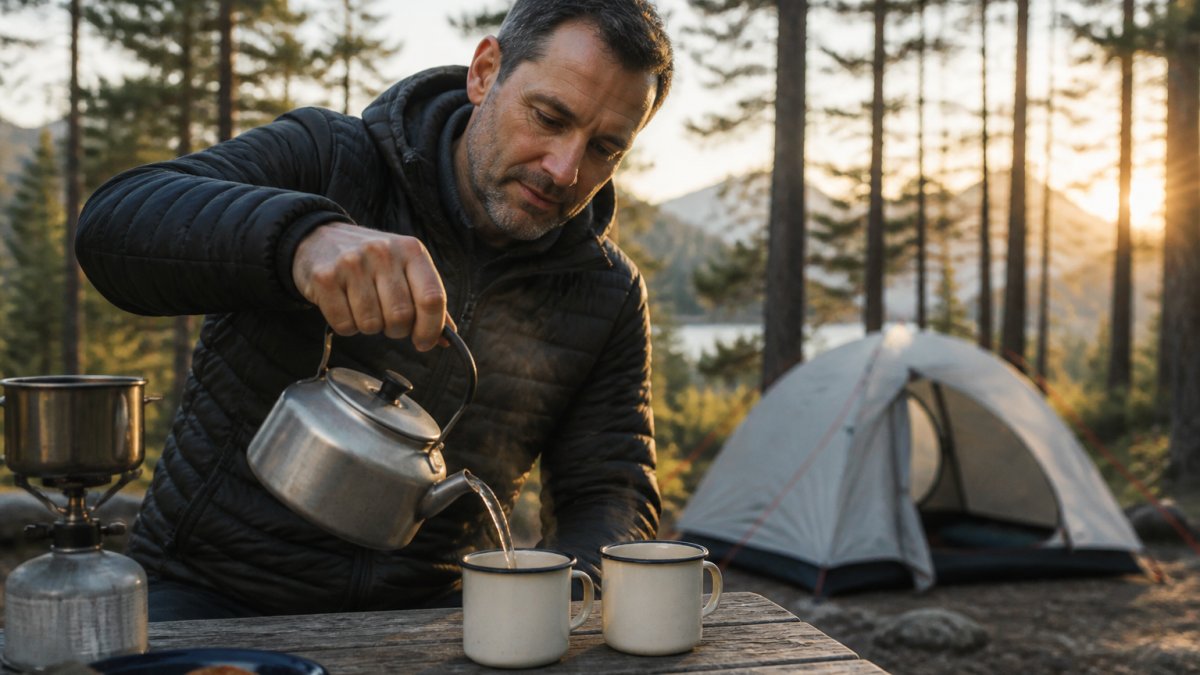
Solo hikers do well with 0.6 to 0.8 L; couples should look at 0.8 to 1 L; groups of three or more are better served by a 1.5 L kettle or boiling in stages.
Two notes: a kettle filled past three-quarters is a pouring hazard on uneven ground, and for pour-over coffee a smaller gooseneck kettle gives more control than a large wide-spout one.
- 0.6-0.8 L: one to two people, tea and instant coffee
- 0.8-1 L: two people, or one person who drinks a lot of tea
- 1.5 L+: three or more, or basecamp use
Stove Compatibility, Boil Times and Fuel Efficiency
Stove compatibility comes down to base diameter, pot support geometry, and material. A narrow kettle on a wide burner wastes heat up the sides; a wide kettle on a tiny ultralight stove can tip.
Canister stoves (e.g., MSR PocketRocket, Jetboil Flash): Three or four pot supports work with most kettles up to about 1 L. The Jetboil Flash is designed around its own pot, so a separate kettle sits less securely.
Alcohol stoves (e.g., Trangia, Toaks): A wide, low flame spreads outward, so these prefer a wider, lower base, 12-14 cm, for stability and efficiency. A narrow titanium kettle often tips or scorches. Stainless steel tolerates the lower heat output without warping.
Wood-burning stoves (e.g., Solo Stove, Bushbuddy): These require a flat, wide base on the internal grate. Thin titanium can dent under a full kettle on uneven ground; stainless steel or hard-anodized aluminum is more stable.
Open fires: Only stainless steel or heavy-duty titanium belongs directly on coals or flames. Thin titanium can warp or develop pinholes; aluminum can melt if the fire is too hot. Always use a lid to keep ash out.
Boil times and fuel efficiency: Boil time depends on volume, base width, lid use, and wind.
Fuel efficiency follows the same logic: wider base, lid on, sheltered flame, and water starting at ambient temperature. On a cold morning, warming your water bottle in your sleeping bag overnight saves real fuel.
To compare kettles honestly, boil the same volume on the same stove on the same day and time it, the only test that means anything for your setup. Record starting water temperature and wind conditions so your notes stay useful.
Packing, Nesting and Durability on the Trail
Packing and nesting decide whether a kettle earns permanent space in your kit. The best one swallows your stove, a lighter, and a bag of tea, then disappears into a pot. Here are the dimensions that matter.
Packed dimensions: A typical 0.8 L kettle is about 12-14 cm in diameter and 10-12 cm tall with the handle folded; a 1 L kettle is often 14-16 cm wide and 12-14 cm tall. Measure your cook kit before buying, a kettle that nests inside your pot saves more pack volume than a lighter one that rattles loose.
Handle folding: Flat-folding handles matter, one that sticks out adds bulk and catches on gear, and removable spouts let the kettle sit lower in a pack. Some kettles have a bail handle that folds over the lid; others a side handle that folds against the body. Test the fold before buying; a stiff handle that won't stay folded is a nuisance.
Nesting with stoves and canisters: With a canister stove, check the kettle's base sits on the pot supports without wobbling. A 100 g fuel canister (e.g., MSR IsoPro) is about 9 cm in diameter and 7 cm tall and often fits inside a 1 L kettle with the lid removed.
Durability and repairability: Durability comes down to three failure points:
- Handle rivets: the first thing to loosen on a cheap kettle. Riveted handles can often be tightened with a small punch or replaced with a wire bail. Bonded or glued handles usually cannot be fixed in the field.
- Lid fit: a loose lid falls off mid-pour and burns you. Look for a lid that snaps or fits snugly. A lid with a silicone gasket can degrade over time; a metal-to-metal fit is more durable but may loosen with heat cycles.
- Spout seam: the weakest point on thin-walled kettles. Titanium can crack at the seam if dropped; stainless steel dents but rarely cracks. Hard-anodized aluminum can scratch, exposing bare aluminum, which corrodes over time.
Long-term field use: Titanium dents rather than cracks, but repeated dents can cause a pinhole leak. Stainless steel is nearly indestructible but heavier. Hard-anodized aluminum is a middle ground, though the coating wears off after years of scrubbing, avoid steel wool. For repairability, a stainless steel kettle with riveted hardware is easiest to fix in the field; titanium needs specialized tools.
What to Ignore When Buying Lightweight Camping Tea Kettles
Ignore the gram count on the box, the "ultralight" label, and any claim that doesn't state whether the weight includes the lid. Those three mislead more buyers than anything else.
Also ignore:
- Whistling features: extra parts that break, and pointless when you are standing right there
- Non-stick coatings: they scratch, flake, and add nothing to a water-only kettle
- Oversized spouts: they pour fast and sloppy, which is the opposite of what tea and pour-over need
- Bundled "camp kitchen" sets: you pay for items you will leave at home
The one thing worth paying more for is a lid that fits tightly and a handle that stays cool. Those two details decide whether you enjoy using the kettle or dread it.
Conclusion
Choosing among lightweight camping tea kettles comes down to matching material, weight, and capacity to how you actually boil water, not the lowest number on a spec sheet.
Old Guy Outdoors exists for exactly that morning moment: a fresh cup at the tent door or on the tailgate. Our coffee is roasted to order for maximum flavor and aroma, our teas are carefully sourced, and delivery is fast and reliable. Experience the authentic taste of adventure and the ease of an ordering process designed to enhance your most memorable moments.
Frequently Asked Questions
How much should a backpacking kettle weigh?
For solo hikers, a titanium or hard-anodized aluminum kettle between 100g and 200g is a realistic target. Kettles above 300g start to compete with your stove and pot for pack weight. Check the packed weight including the lid and handle, not just the bare body, because handles and lids add 20g to 50g. If you only boil water for tea and coffee, a kettle under 150g keeps your base weight low without sacrificing capacity.
Are titanium camping kettles worth it for backpacking?
Titanium costs more than aluminum, but it saves weight and resists corrosion, which matters if you boil water daily on multi-day trips. A titanium camping kettle also handles direct flame well and won't leave a metallic taste in your tea. The trade-off is heat distribution: titanium heats unevenly, so you need a stove with a wider flame spread. If you hike a few weekends a year, hard-anodized aluminum gives most of the benefit for less money.
What size camping kettle is best for one or two hikers?
A 0.8L to 1L kettle covers one or two people for tea and coffee, since a standard mug holds around 300ml and you rarely fill it to the brim. For three or more hikers, look at 1.5L. Capacity also affects packability: a 1L kettle nests around a small gas canister and a folding stove, while larger kettles take up real space. Match capacity to your group size rather than buying the biggest option.
Can you use a camping kettle over a campfire?
Stainless steel and titanium kettles handle campfire use, but aluminum can warp or scorch if flames lick the sides. Keep the kettle on coals or a low flame rather than direct high flames, and avoid models with plastic handles or silicone grips near the base. If you mainly cook on a camp stove, a kettle with a folding handle and a tight lid is easier to manage in wind and gives you better pouring control.