
How Long Does Roasted Coffee Stay Fresh
Table of Contents
- How Long Does Roasted Coffee Stay Fresh: The Timeline
- Peak Flavor vs. Safe to Drink: What Actually Changes
- How to Store Coffee Beans for Maximum Freshness
- The Degassing and Resting Period After Roasting
- How Long Do Coffee Beans Last: Storage Conditions Matter
- How to Tell If Coffee Beans Are Stale
- Freezing Coffee Beans for Long-Term Storage
- Roast Date, Brewing Method, and Freshness Perception
- A Step-by-Step Storage Routine for Maximum Flavor
- Frequently Asked Questions
Last Updated: October 12, 2026
How Long Does Roasted Coffee Stay Fresh: The Timeline
How roasted coffee stay fresh depends on two main factors: whether the beans are whole or ground, and how you store them. Whole-bean coffee stays fresh longer than ground coffee. Ground coffee loses its flavor faster because it has more surface area exposed to air.
Whole-bean coffee freshness
Whole beans maintain their peak flavor for about two to four weeks after roasting. This window is when the coffee tastes its best. After four weeks, the beans don't spoil or become unsafe to drink. They simply taste less vibrant and aromatic.
For the first five to seven days after roasting, the beans are still degassing. This means they're releasing carbon dioxide that was trapped during the roasting process. Many coffee experts recommend waiting until day five or six before brewing whole beans. This resting period allows the flavors to settle and develop properly.
After two to four weeks, whole beans continue to be drinkable for several more weeks. However, the flavor quality declines noticeably. By six weeks, most whole beans have lost significant aroma and taste complexity.
Ground coffee freshness
Ground coffee has a much shorter freshness window than whole beans. Once you grind roasted coffee, it stays fresh for only five to ten days in an airtight container. The grinding process exposes far more surface area to oxygen, which causes rapid oxidation.
If you grind your coffee and leave it exposed to air, it becomes noticeably stale within hours. The aroma fades quickly. For best results, grind your beans just before brewing. This simple step preserves the flavor that Old Guy Outdoors builds into every roasted batch.
Peak Flavor vs. Safe to Drink: What Actually Changes
Peak flavor and food safety are two completely different things. Coffee doesn't go bad in a way that makes it unsafe to drink. What changes is taste and aroma quality.
Peak flavor occurs during the first two to four weeks after roasting. The coffee tastes bright, aromatic, and complex. The flavor notes shine through clearly in your cup.
After peak flavor passes, the coffee enters an acceptable flavor zone. It still tastes good, but less vibrant. You can drink coffee in this phase without any safety concerns. The taste is simply less exciting than freshly roasted beans.
Around six weeks after roasting, coffee enters the stale phase. It's still safe to drink, but the aroma is muted and the flavor is flat. Many people find it unpleasant at this point, though it won't harm you.
The key difference: freshness is about flavor quality, not food safety. Roasted coffee doesn't develop mold, bacteria, or toxins over time the way fresh foods do. It simply loses its appeal through oxidation and degassing.
How to Store Coffee Beans for Maximum Freshness
Storage conditions directly control how long your roasted coffee stays fresh. The right container and environment can extend peak flavor by days or even weeks.
Unopened bags with one-way valves
Most specialty roasters ship coffee in bags with one-way valves. These valves let carbon dioxide escape during degassing but prevent oxygen from entering. This design keeps unopened bags fresh longer than you might expect.
An unopened bag with a one-way valve can maintain peak flavor for three to four weeks after roasting. The valve does its job well during the critical degassing period. Store unopened bags in a cool, dark place away from direct sunlight and heat sources.
Don't refrigerate unopened bags. The temperature swings and moisture in a fridge can damage the beans. A pantry or cupboard at room temperature works perfectly.
Opened bags and containers
Once you open a bag, the one-way valve stops protecting your beans. Oxygen enters every time you open it. Transfer your beans to an airtight container as soon as possible.
The best containers are airtight glass jars or metal tins with tight-sealing lids. Avoid clear plastic containers. Light penetrates plastic and speeds up oxidation. Dark glass or opaque containers work much better.
Store your airtight container in a cool, dark place. Room temperature is ideal. Keep it away from direct sunlight, heat sources like ovens or radiators, and moisture-prone areas like kitchens near the sink.
An opened bag stored in an airtight container stays fresh for two to three weeks. This assumes proper storage conditions. If you leave the container in a warm or sunny spot, the timeline shortens considerably.
The Degassing and Resting Period After Roasting
Degassing is the process where roasted coffee beans release trapped carbon dioxide. This happens automatically after roasting. Understanding degassing helps you time your brewing for best flavor.
During the first 24 to 48 hours after roasting, degassing happens rapidly. The beans feel slightly warm and release visible gas. During this period, brewing can produce an uneven extraction. The gas interferes with water contact with the bean surface.
By day five or six, degassing slows significantly. The resting period is complete. Most coffee professionals recommend brewing after day five for this reason. The flavor has settled, and the extraction is more controlled.
Degassing continues slowly for several weeks, but the major release happens in the first week. This is why that first week matters so much for flavor development. The beans are still changing during this time.
How Long Do Coffee Beans Last: Storage Conditions Matter
Storage conditions don't just change how long coffee stays fresh, they change how it ages. The four main variables are oxygen, light, heat, and moisture. Each one attacks coffee differently, and understanding the mechanism helps you prioritize your storage setup.
Oxygen: the primary driver of staleness
Oxygen reacts with the oils and aromatic compounds in roasted coffee through oxidation. This process starts the moment beans are exposed to air and accelerates with more surface area (ground coffee) and higher temperatures. The practical result: whole beans stored in an airtight container at room temperature can hold peak flavor for two to four weeks, while the same beans left in an open bag may taste flat within days.
A common pattern is that oxygen damage is cumulative. Every time you open a container, fresh air enters. If you open your coffee multiple times a day, you're effectively speeding up the clock. This is why single-dose storage or smaller containers can help frequent brewers.
Light: the invisible accelerator
Ultraviolet (UV) light breaks down the chemical bonds in coffee oils, leading to stale, cardboard-like flavors. Clear glass jars on a sunny countertop are one of the worst storage choices for this reason. Dark glass, opaque ceramic, or metal containers block light entirely. If you prefer clear jars for aesthetics, store them in a cabinet, not on an open shelf.
A common mistake is leaving beans in the hopper of a grinder exposed to kitchen light. Even indirect light over several days can dull the aroma. If your grinder hopper is clear, consider transferring only a day's worth of beans at a time.
Heat: speeds up every reaction
Heat accelerates oxidation and degassing. Coffee stored near an oven, radiator, or in direct sunlight will age faster than coffee stored in a cool pantry. Room temperature, roughly 68-72°F (20-22°C), is ideal. Avoid storing coffee above the refrigerator or in a cabinet next to the stove.
A less obvious heat source: the top of a coffee maker or espresso machine. These areas radiate warmth and can degrade beans within days. Keep your storage container away from any appliance that generates heat.
Moisture: the enemy of texture and safety
Moisture damages roasted coffee in two ways. First, it can cause the beans to swell and lose their crisp texture, which affects grinding consistency. Second, in extreme cases, moisture can promote mold growth, though this is rare in properly stored roasted coffee. High-humidity environments (near sinks, dishwashers, or in tropical climates) require extra care.
Never store coffee in the refrigerator. The fridge cycles through temperature changes and introduces moisture every time the door opens. Condensation inside a container can ruin beans quickly. If you must use the freezer, follow the dedicated freezing steps later in this article.
The hierarchy of storage factors
If you can only control one variable, control oxygen. An airtight container in a cool, dark place covers most of the battle. Light and heat are secondary but still matter over weeks. Moisture is less of a concern in typical home kitchens but becomes critical in humid climates or if you introduce condensation through refrigeration.
How to Tell If Coffee Beans Are Stale
You can assess freshness using three simple methods: check the roast date, smell the aroma, and taste the brew.
Check the roast date. Most bags show a roast date. Coffee roasted more than six weeks ago is likely stale. Coffee roasted two to four weeks ago is in peak flavor. This is the most reliable indicator.
Smell the aroma. Fresh coffee has a strong, pleasant aroma. Stale coffee smells flat or dull. Open your container and take a deep breath. If the smell is weak, the coffee is past peak flavor.
Taste the brew. Fresh coffee tastes bright and complex. Stale coffee tastes flat and one-dimensional. If your cup lacks the flavor notes you expect, the beans are likely stale.
The roast date is your best guide. Aroma and taste are helpful confirmations, but roast date gives you the clearest picture of where your coffee sits in its freshness cycle.
Freezing Coffee Beans for Long-Term Storage
Freezing extends the life of roasted coffee significantly. However, it requires proper technique to work well.
When freezing makes sense
Freezing makes sense if you buy coffee in bulk or want to store beans for longer than six weeks. Frozen beans stay fresh for several months. This is useful for people who don't brew coffee frequently or who want to stock up during sales.
Freezing does not improve coffee. It simply slows down the oxidation process. The flavor won't be as vibrant as freshly roasted beans, but it will be better than room-temperature beans that have been sitting for months.
Proper freezing and thawing steps
Freeze whole beans only, not ground coffee. Grinding frozen beans is difficult, and ground coffee doesn't freeze well.
Step 1: Portion your beans. Divide your coffee into small portions. Freeze only what you'll use in one to two weeks at a time. Smaller portions mean fewer thaw cycles, which reduces quality loss.
Step 2: Use an airtight container. Place each portion in a small airtight container or freezer bag. Remove as much air as possible. Proper sealing prevents freezer burn.
Step 3: Label with the date. Write the freeze date on the container. This helps you track how long the beans have been frozen.
Step 4: Thaw at room temperature. Remove beans from the freezer and let them thaw in a sealed container for 30 minutes to one hour. Do not open the container while thawing. This prevents condensation from forming on the beans.
Step 5: Brew immediately after thawing. Once thawed, brew your coffee right away. Don't re-freeze thawed beans.
Roast Date, Brewing Method, and Freshness Perception
Not all brewing methods reveal staleness equally. The way you brew changes how much of the coffee's aging you actually taste. Understanding this helps you set realistic expectations and decide when to finish a bag.
Why brewing method changes perception
Espresso is the most unforgiving. It uses high pressure and a short extraction time, which amplifies both good and bad flavors. Stale beans produce thin, sour, or muddy shots with weak crema. Many espresso enthusiasts find that beans older than two to three weeks post-roast lose the sweetness and complexity they expect. However, this isn't a hard rule, some darker roast blends designed for espresso can hold up longer because their flavor profile is less delicate.
Filter coffee and pour-over are more forgiving. The longer contact time and paper filtration can mask some stale notes. A coffee that tastes flat as espresso might still make an acceptable drip cup. That said, the aroma will still be muted, and the finish may be shorter. A common pattern is that filter brewers notice staleness around four to six weeks post-roast, depending on storage.
Immersion methods like French press and AeroPress fall somewhere in between. They extract more of the bean's character, including the dull notes of stale coffee, but the full-immersion process can also round off harsh edges. If your French press coffee tastes bland rather than offensive, it's likely past peak but not ruined.
Cold brew is the most forgiving of all. The cold, slow extraction minimizes the perception of staleness. Beans that are six to eight weeks old can still produce a decent cold brew concentrate, though the flavor will be less vibrant than with fresh beans.
Roast level and aging
Lighter roasts tend to show staleness faster because their flavor profile is more delicate and acidic. The bright, fruity, or floral notes fade quickly, leaving a flat, grassy taste. Darker roasts have bolder, more dominant flavors from the roasting process itself, think chocolate, caramel, or smoke, which can mask some staleness. This doesn't mean dark roasts stay fresh longer in a chemical sense; they just hide the decline better.
A common misconception is that oily beans are always stale. In reality, oily beans are often a sign of a darker roast or a bean that has been stored for a while, but they can still be fresh. Conversely, dry-looking beans can be stale if they've been exposed to air. Use roast date and aroma as your primary guides, not oiliness.
Bean type and processing
Bean density and processing method can influence how quickly coffee ages, but the differences are subtle compared to storage and roast level. Washed coffees tend to have cleaner, more delicate flavors that may show staleness sooner. Natural or honey-processed coffees often have heavier body and fruitier notes that can persist a bit longer. These are general tendencies, not strict rules.
A practical freshness checklist
Instead of relying on a single number, use this three-step assessment:
- Check the roast date. If it's within two to four weeks, you're likely in peak flavor. Four to six weeks is acceptable but declining. Beyond six weeks, expect staleness.
- Smell the beans. Fresh coffee has a strong, complex aroma. If the smell is weak or smells like cardboard or hay, it's past peak.
- Taste the brew. Compare a cup to your memory of the same coffee when it was fresh. If the brightness and finish are gone, it's stale, even if it's still safe to drink.
Remember: freshness is about flavor, not safety. Even stale coffee is generally safe to drink. The goal is to enjoy your coffee at its best, and that means paying attention to roast date, storage, and how your brewing method reveals age.
A Step-by-Step Storage Routine for Maximum Flavor
A simple routine keeps your coffee fresh from arrival to brewing.
Day 1: Receive and inspect. Check the roast date on your bag. If it's within the last few days, the beans are still degassing. Store the unopened bag in a cool, dark place.
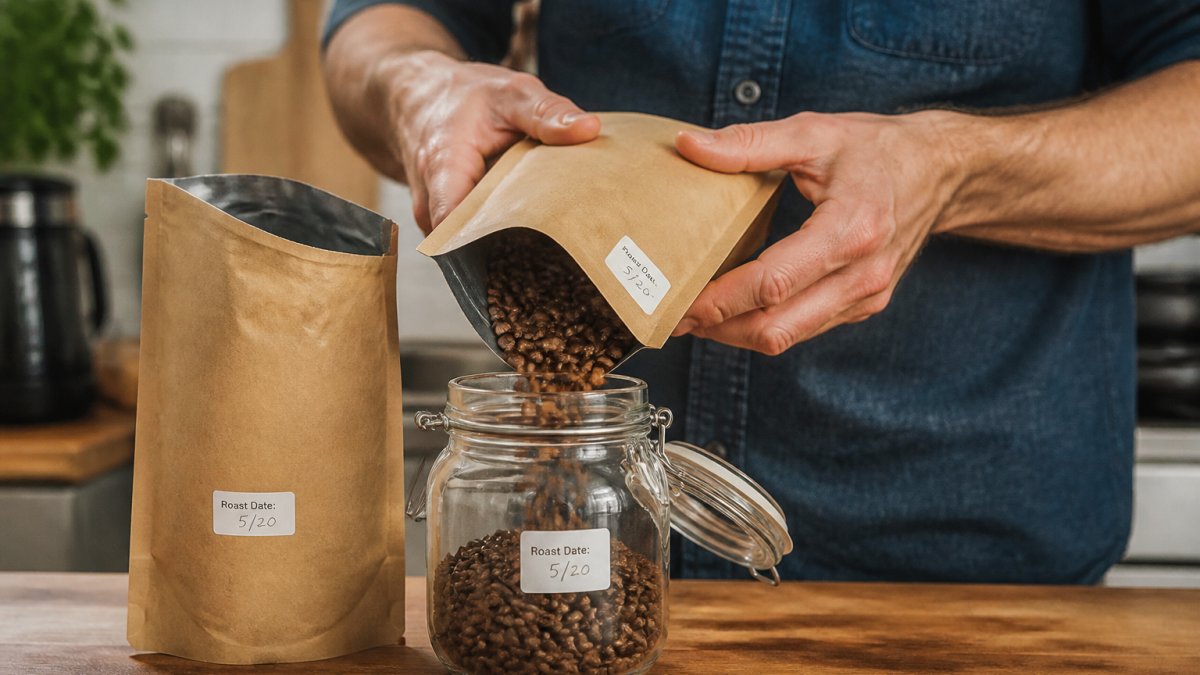
Hands carefully transferring roasted coffee beans from an opened bag into an airtight glass container on a kitchen counter, with a roast date label visible on both the original bag and the container
Day 5 or 6: Transfer to airtight container. Once degassing is mostly complete, transfer your beans to an airtight container. Use a dark glass jar or opaque tin with a tight-sealing lid. Remove as much air as possible before sealing.
Weekly: Check the seal. Every few days, confirm your container lid closes tightly. A loose seal lets oxygen in and speeds oxidation.
Brewing day: Grind fresh. Grind only the beans you'll use immediately. Store the rest in the sealed container. Grinding right before brewing preserves maximum flavor.
After four weeks: Evaluate. Check the aroma and taste. If the coffee is still within peak flavor, continue your routine. If it's noticeably stale, consider freezing the remaining beans or switching to a fresh batch.
This routine takes minimal effort but dramatically extends freshness. The key steps are storing in a cool, dark place, using an airtight container, and grinding just before brewing.
How long roasted coffee stays fresh depends on storage conditions and brewing habits. Most whole-bean coffee peaks in flavor during the first two to four weeks after roasting, then gradually declines. At Old Guy Outdoors, we roast to order so your coffee arrives at peak freshness. Our House Blend and Breakfast Blend are designed to develop their full flavor profile within that critical first week. Proper storage in a cool, dark, airtight container extends peak flavor and ensures every cup tastes as intended. Start with whole beans, grind fresh, and store sealed, these three habits make the biggest difference in cup quality.


Frequently Asked Questions
How long does roasted coffee stay fresh after roasting?
Roasted coffee stays fresh for 2-4 weeks after roasting when stored in an airtight container away from heat and light. Whole beans retain flavor longer than ground coffee, which begins to lose aroma within days of grinding. Peak flavor typically occurs 5-10 days after roasting, once degassing is complete. After four weeks, the beans are still safe to drink but will taste noticeably stale and lack the vibrant aroma you'd expect from freshly roasted coffee.
How long should you wait to brew coffee after it has been roasted?
Wait 5-10 days after roasting before brewing for the best flavor. Freshly roasted beans release carbon dioxide during degassing, which can cause uneven extraction and bitter flavors if brewed too soon. This resting period allows the beans to stabilize and develop their intended flavor profile. However, coffee is safe to drink immediately after roasting if needed—it just won't taste its best. Old Guy Outdoors roasts to order, so your coffee arrives at the ideal point in this window.
Can you freeze roasted coffee beans for long-term storage?
Yes, freezing works well for long-term storage beyond 4 weeks. Store beans in an airtight, moisture-proof container in the freezer for up to 3-6 months. Thaw the sealed container at room temperature for 1-2 hours before opening to prevent condensation from exposing beans to moisture. Freeze whole beans, not ground coffee, to preserve more flavor. Freezing halts oxidation but doesn't improve flavor—use this method only when you can't drink your coffee within the normal 2-4 week window.
How can you tell if roasted coffee has gone stale?
Check three indicators: roast date (past 4 weeks suggests staleness), aroma (weak or absent smell means oxidation has occurred), and brew results (flat, muted taste without the brightness or complexity you expect). Stale coffee isn't unsafe to drink, but it lacks the vibrant flavor and aroma of fresh beans. If your coffee smells musty, moldy, or rancid, discard it—these signs indicate moisture damage or contamination, not just age.